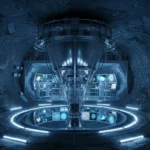
A groundbreaking telescope located deep underground in Japan is on the verge of detecting cosmic neutrinos, often referred to as “ghost particles,” from supernovae that occurred before the formation of the Sun and Earth. These elusive particles, remnants of ancient stellar explosions, could be observed for the first time this year, thanks to advancements in the Super-Kamiokande observatory.
Supernovae, the explosive deaths of massive stars, have long intrigued astronomers. Historically, these events, like the one observed by Tycho Brahe in 1572, have been visible to the naked eye. However, the true energy of a supernova is carried by neutrinos, which are nearly invisible and pass through matter almost undetected. The enhanced capabilities of the Super-Kamiokande telescope now allow scientists to capture these “ghost” particles, offering insights into stars that died 10 billion years ago.
This year, scientists anticipate the first detection of these ancient particles, made possible by the recent upgrade to the Japanese observatory. This development marks a significant milestone in astrophysics, as it enables the observation of particles produced before Earth’s existence. Neutrinos, lacking electrical charge, travel through space unimpeded, making them perfect messengers of cosmic history.
Astrophysicists are eager to understand what remains after a star’s explosion. The core may collapse into a black hole or form a neutron star, a dense object about the size of a city. By detecting the collective signals of past supernovae, scientists hope to unravel these mysteries and study the lifecycle of stars throughout the universe’s history.
Supernovae are rare in our galaxy, occurring once every few decades, but across the universe, a massive star explodes every second. These explosions release immense energy, primarily as neutrinos. Capturing these particles for the first time will allow astronomers to piece together the history of all massive stars. The year 2026 could herald a new chapter in astronomy, as the Japanese telescope begins to reveal the faint glow of the universe’s oldest explosions.