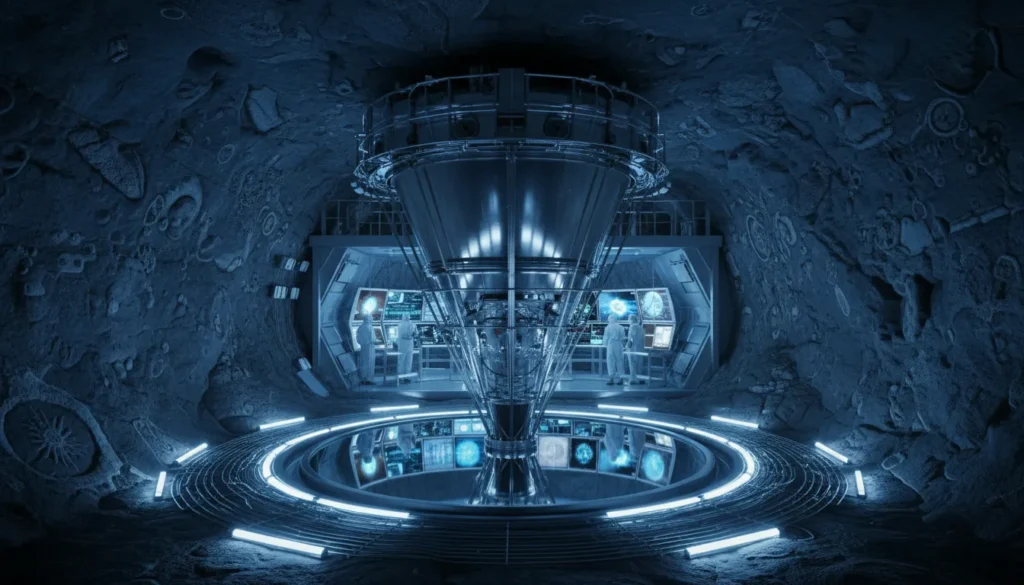

A groundbreaking underground telescope in Japan is on the verge of detecting cosmic neutrinos, often referred to as “ghost particles,” from ancient stellar explosions. These particles, remnants of stars that perished before the formation of the Sun and Earth, might be observed for the first time this year, thanks to advancements in the Super-Kamiokande observatory.
Neutrinos, elusive particles that rarely interact with matter, are the primary carriers of energy from supernovae. Despite their abundance, they are almost invisible, passing through matter without being absorbed. The Super-Kamiokande’s recent upgrades have enhanced its ability to capture these particles, potentially allowing scientists to study explosions from stars that died billions of years ago.
Astrophysicists are eager to explore what remains after a star’s explosive demise. The collapse of a star’s core might result in a black hole or a neutron star, an incredibly dense object about the size of a city. By detecting the cumulative signals of past supernovae, researchers hope to unravel these mysteries and gain insights into the life cycles of stars throughout the universe’s history.
Supernovae are infrequent in our galaxy, occurring once every few decades. However, on a universal scale, a massive star explodes approximately every second. While only a small fraction of the energy from these explosions is visible light, the vast majority is emitted as neutrinos. Capturing these particles will provide a new perspective on the universe’s history, marking a significant milestone in astronomical research.
This year could herald a transformative moment in astronomy, as scientists prepare to observe not just nearby stellar explosions but the collective history of all massive stars. The journey begins with a telescope deep beneath the Japanese soil, poised to detect the faint, ghostly glow of the universe’s oldest explosions.
