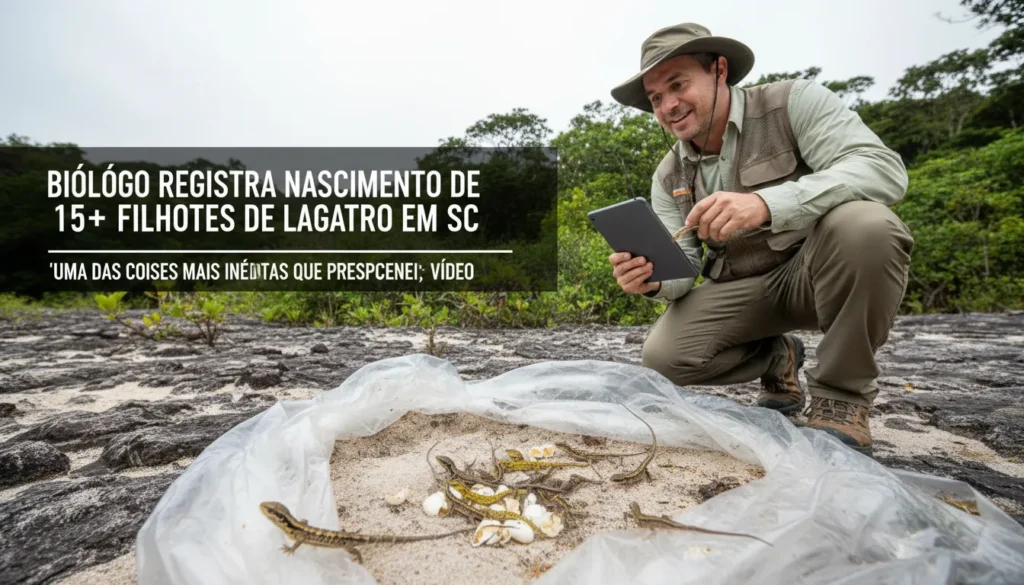

In a remarkable event in Jaraguá do Sul, Santa Catarina, biologist Christian Raboch captured the hatching of over 15 teiú lizard hatchlings after a local resident delivered a box containing the eggs. Concerned about the potential number of animals emerging in his yard, the resident handed the eggs over to Raboch, who works with the Fundação Jaraguaense de Meio Ambiente (Fujama). The video documenting this unique occurrence has garnered over 873,000 views.
Christian Raboch received the teiú eggs earlier in the month from a resident who discovered them in his garden. Worried about the implications of a large number of reptiles, the resident decided to remove the eggs. Raboch explained, “The resident thought, ‘What if these are snakes or lizards? There will be too many here,’ and thus removed the eggs.”
The video shows the eggs nestled in soil, with two hatchlings already emerging, and Raboch assisting a third. Eventually, 16 lizards were born and subsequently released into a nearby forested area. The species, known as Salvator merianae or teiú-comum, requires specific conditions for successful hatching, such as maintaining adequate humidity levels.
Raboch shared insights about the species, noting that teiú eggs take between 60 and 90 days to hatch. Unlike birds, the parents do not incubate the eggs, and the hatchlings are independent from birth. While parental care is generally absent, one adult may guard the nest. The lizards reach maturity within two to three years, although not all offspring survive.
During the incubation period, Raboch ensured the eggs remained moist, as dryness can impede embryo development. He cautioned against prematurely opening the eggs, as this could lead to premature births and fatalities. In this case, assistance was only given when a hatchling had already begun breaking through the shell.