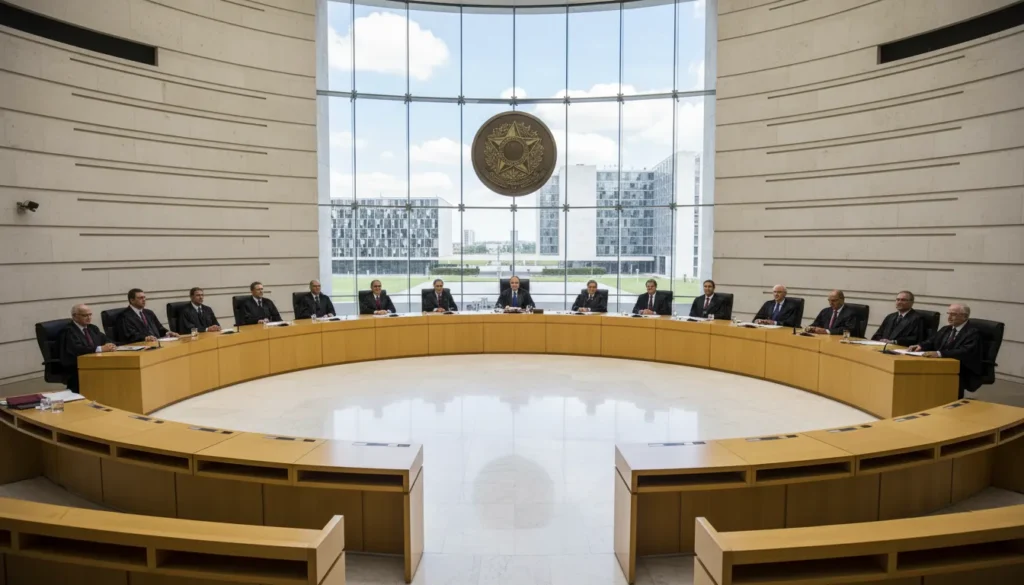

The Brazilian Supreme Court, known as the Supremo Tribunal Federal (STF), is composed of 11 justices appointed by the nation’s presidents and confirmed by the Senate. Currently, President Luiz Inácio Lula da Silva has nominated Jorge Messias, the Attorney General, for a seat on the court. If confirmed, Lula will have appointed five active justices during his current term. The selection process for justices requires candidates to be between 35 and 70 years old, possessing notable legal expertise and an unblemished reputation.
The STF’s current lineup includes justices appointed by various presidents. Gilmar Mendes, the longest-serving member, was appointed by Fernando Henrique Cardoso in 2002. Cármen Lúcia, appointed by Lula in 2006, was the first woman to lead the Superior Electoral Court. Other notable justices include Dias Toffoli, also appointed by Lula, who served as the youngest president of the STF, and Luiz Fux, appointed by Dilma Rousseff, who led the court during the COVID-19 pandemic.
Recent additions to the court include Alexandre de Moraes, appointed by Michel Temer, and Nunes Marques and André Mendonça, both appointed by Jair Bolsonaro. Lula’s recent nominations include Cristiano Zanin and Flávio Dino, both appointed in 2023. Zanin gained prominence for defending Lula in the Lava Jato operation, while Dino has a background as a federal judge and various political roles.
The STF serves as the highest authority in Brazil’s judiciary, tasked with safeguarding and interpreting the Constitution. It adjudicates cases challenging the legality of laws and regulations and handles criminal cases involving high-ranking officials with special legal privileges. The court also reviews lower court decisions when constitutional issues are involved.
