
Introduction
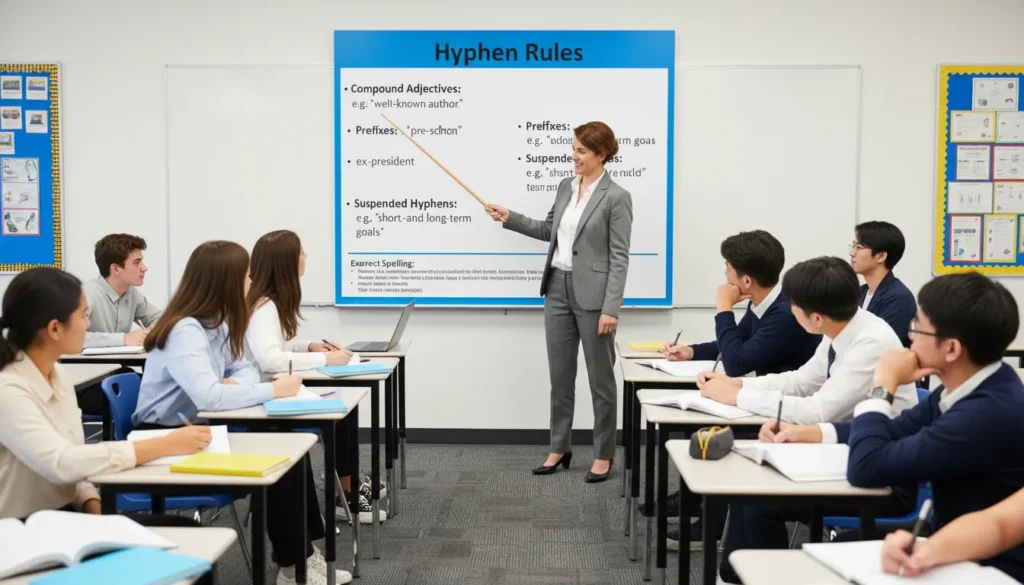
Hyphens are often overlooked elements in written communication, yet they wield significant power in enhancing clarity and precision. This article aims to demystify hyphen usage, covering essential rules, common mistakes, and practical tips for effective application. By understanding how to use hyphens correctly, you can prevent misunderstandings and ensure your writing conveys the intended message. Throughout this article, you’ll learn the updated guidelines for hyphenation, common pitfalls to avoid, and strategies for mastering this crucial aspect of grammar, equipping you with the tools needed to improve your written communication skills.
Summary
Hyphens are vital for clarity in writing, impacting meaning significantly. This article explores hyphen usage rules, common errors, and practical tips for correct application. Mastering hyphen use is essential for effective communication in both personal and professional contexts.
The Importance of Hyphens in Written Communication
Hyphens play a crucial role in written communication, acting as important tools for clarity and precision. Their use can drastically change the meaning of a sentence, making it essential for writers to understand their correct application. For instance, consider the difference between ‘man-eating shark’ and ‘man eating shark.’ The former implies a shark that consumes humans, while the latter could suggest a man who is consuming shark meat. Such fundamental differences underscore the significance of hyphens in conveying the intended message.
Hyphens also facilitate the creation of compound modifiers, which help in providing specific descriptions of nouns. For example, phrases like ‘high-speed chase’ and ‘well-known author’ illustrate how hyphens can enhance comprehension by linking words that work together as a single idea. Additionally, they serve to prevent ambiguity by clarifying relationships among words, thus guiding the reader more effectively. To explore more on effective writing, refer to our guide on improving written communication.
In professional writing, especially within the realm of technical communication such as seen in Automação Teste, the failure to use hyphens appropriately can lead to misunderstandings. This is particularly true in instances where precision is paramount, such as in instruction manuals or policy documents.
Moreover, hyphens are not just a matter of aesthetic; they are essential for maintaining a professional tone. They contribute to the overall readability of the text, making it easier for audiences to grasp complex ideas quickly. Therefore, understanding how to use hyphens correctly is critical for anyone looking to master written communication.
Updated Rules for Hyphen Usage
Understanding the updated rules for hyphen usage is essential for clear and effective writing. Hyphens are often employed to create compound words, combine descriptors, and aid in clarity. However, recent linguistic trends have necessitated a reevaluation of these conventional uses.
Firstly, compound adjectives preceding nouns typically require hyphens. For example, in the phrase ‘high-quality product,’ a hyphen links ‘high’ and ‘quality’ to clarify that they modify ‘product’ as a single descriptor. However, it is essential to recognize that when these compound adjectives follow the noun, the hyphen is usually dropped, such as in ‘the product is high quality.’
Secondly, hyphenation plays a crucial role in avoiding ambiguity. For instance, ‘re-cover’ (to cover again) and ‘recover’ (to regain health) demonstrate how hyphenation can clarify meaning. Without a hyphen, confusion may arise, potentially distorting the intended message.
Thirdly, guidelines around prefixes have also shifted. Commonly used prefixes such as ‘un-‘ or ‘re-‘ do not necessitate hyphenation when preceding a word, unless they precede a proper noun (e.g., ‘un-American’).
Additionally, consecutive words joined by a hyphen cannot be separated within sentences. A clear example is ‘mother-in-law,’ which must remain intact to maintain its meaning. Furthermore, when enumerating multiple descriptors, avoid hyphenating each element unless absolutely necessary. This enhances readability, maintaining fluidity in your writing. For more tips on how to improve hyphen use for your writing projects, you may find it helpful.
Overall, mastering the updated rules of hyphen usage is vital for effective communication, ensuring clarity and precision in your writing. Consider utilizing automation techniques if you are looking to streamline your writing process.
Common Mistakes in Hyphen Use
Hyphen errors frequently occur in writing and can lead to confusion or misinterpretation. One common mistake is using a hyphen between two words that should remain separate. For example, in ‘high quality products,’ the correct form is without a hyphen. Thus, it becomes essential to understand when hyphens are necessary to avoid such pitfalls.
Another frequently observed error is in the incorrect joining of compound adjectives. For instance, in phrases like ‘a ten-year-old girl,’ the hyphen is necessary to clarify that the girl is ten years old, as opposed to suggesting she is simply ten years old and belongs to something else. Omitting the hyphen here could mislead the reader. To learn more about compound adjectives, refer to our detailed guide.
Additionally, confusion arises in compound nouns where the choice to hyphenate or not can modify meaning. A prime example is ‘mother-in-law’ which demands hyphenation, whereas ‘grandmother’ does not. Not adhering to these rules can create ambiguity, which readers may find challenging.
In some cases, hyphens are mistakenly used with adverbs that end in ‘ly.’ For example, ‘beautifully-written article’ is incorrect; instead, it should be ‘beautifully written article’ as ‘beautifully’ is an adverb that does not require a hyphen as per grammar rules. For clarity on adverb use, consider exploring resources on grammar rules.
Lastly, a common oversight is in the formation of ages and dates where hyphens may be overlooked. For instance, ‘20-year-old man’ is a necessary hyphenated form, clarifying that the man is twenty years of age. Recognizing these common mistakes is pivotal for mastering hyphen usage. This understanding can greatly enhance your writing skills and overall clarity.
Practical Tips for Mastering Hyphenation
Mastering hyphenation can enhance your writing, making it clearer and more effective. Here are several practical tips to help you navigate hyphen use successfully:
-
Know when to use hyphens in compound adjectives: When a compound adjective precedes a noun, use hyphens to avoid confusion. For example, ‘well-known author’ versus ‘the author is well known’ shows how placement matters.
-
Use hyphens to clarify meaning: When combining words that could lead to ambiguity, hyphens become essential. For example, ‘re-cover’ (to cover again) versus ‘recover’ (to regain ability) demonstrates this clearly.
-
Follow style guides: Different style guides have specific rules for hyphenation. Familiarize yourself with the guidelines of your chosen style, whether it’s APA, MLA, or Chicago, to maintain consistency.
-
Practice with prefixes: Generally, avoid hyphenating prefixes like ‘un’, ‘pre’, or ‘sub’. However, exceptions exist, such as ‘un-American’ and ‘pre-existing’, which highlight the need for careful consideration.
-
Use online resources: When in doubt, refer to online dictionaries or hyphenation tools, which can provide insight into proper usage quickly.
-
Read extensively: Exposure to well-edited texts helps you internalize rules about hyphenation. Observing professionals at work—like those at Automação Teste—can refine your abilities.
By applying these tips consistently, you’ll sharpen your writing skills and ensure clarity through appropriate hyphenation.
Hyphens in Context: Examples and Applications
Hyphens play a critical role in clarifying meaning and ensuring proper sentence structure. Their usage can drastically alter the interpretation of a phrase, making it essential to understand their context and application. For instance, the difference between ‘a small-business owner‘ and ‘a small business owner’ is significant, where the former refers to someone who owns a business that is small in size, while the latter describes a person who operates a business in the small business sector.
Here are several examples illustrating different applications of hyphens:
-
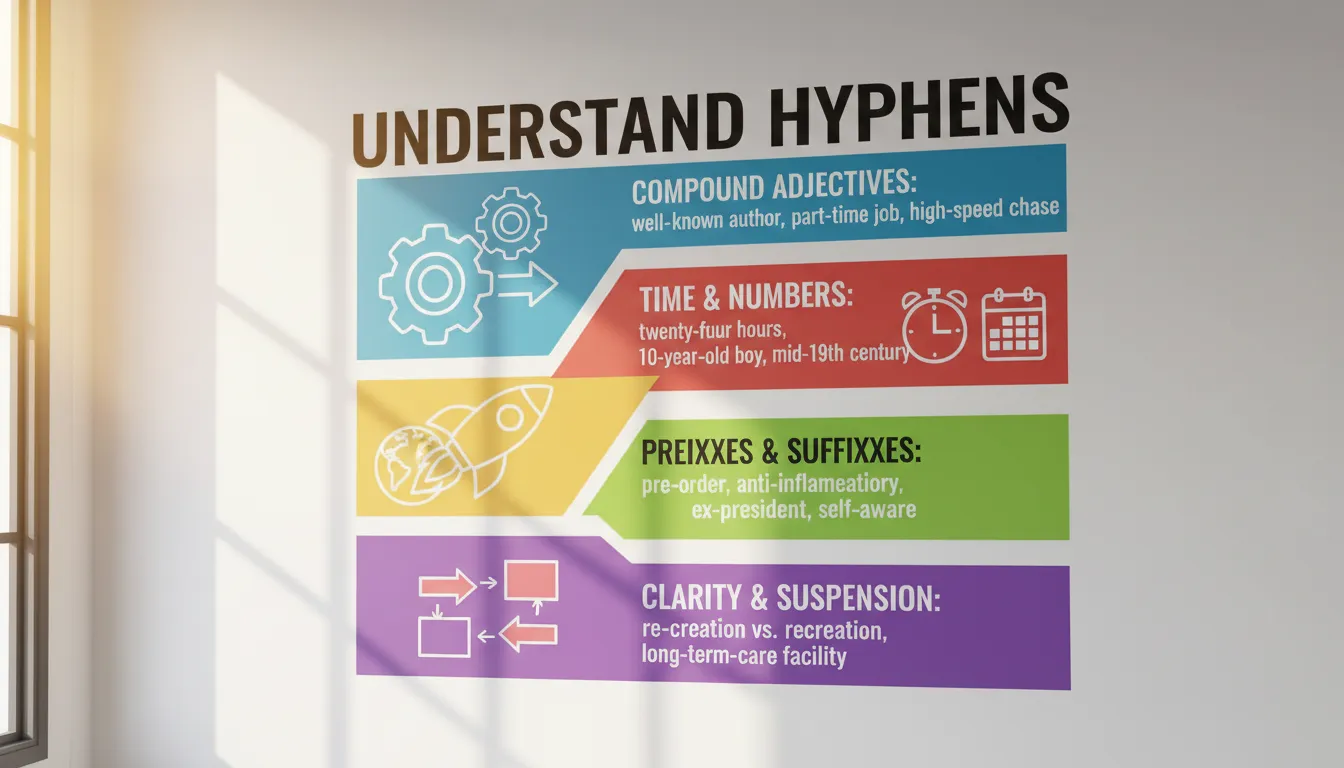
Compound Adjectives:Hyphens are important in compound adjectives when they precede a noun, as in ‘high-quality products’ versus ‘products of high quality.’
-
Age Modifiers: When describing ages, hyphens are necessary, such as ‘a 5-year-old child’ rather than ‘a 5 year old child.’
-
Compound Nouns:Hyphens can help in compound nouns, e.g., ‘mother-in-law’ is clear, while ‘mother in law’ can cause confusion.
-
Prefixes and Suffixes: Certain prefixes and suffixes require hyphenation, as seen in ‘ex-boyfriend’ and self-esteem.
-
Clarifying Meaning:Hyphens can be used to avoid misreading, for example, ‘recover’ versus ‘re-cover’ changes the meaning entirely.
Properly utilizing hyphens enhances clarity, particularly for brands like Automação Teste, whose messaging relies heavily on precise language to communicate automated solutions effectively. Mastering hyphen usage is key to ensuring that your message is conveyed accurately and professionally.
Conclusion
In summary, understanding hyphen usage is crucial for clear and effective written communication. Throughout this article, we explored the importance of hyphens, updated rules for their use, common mistakes to avoid, and practical tips for mastering hyphenation. Proper use of hyphens can greatly impact the clarity of your messages, especially in professional contexts where precision is paramount. As emphasized within the realm of technical communication, the insights shared in this article can empower you to communicate more effectively. By applying these principles and utilizing resources from Automação Teste, you can enhance your writing skills and ensure your messages resonate accurately with your audience. Remember, mastering hyphen usage is a step towards achieving professionalism and clarity in all your written communications.